Today on Monday Mysteries we make consider a mystery of sort about the Civil War photographer Andrew Gardner.
In the current “Dark Fields of the Republic” exhibition at the NPG about Gardner’s photographs. He was an accomplished photographer who was noted for his photographs of battlefields and soldiers during the Civil War. Here’s a description from the exhibition’s website:
Alexander Gardner created dramatic and vivid photographs of battlefields, which included images of the recently dead. These shocking Civil War-era images continue to haunt the national imagination. After the war, Gardner went west, creating unforgettable pictures of western landscape and portraits of American Indians. …
— from http://www.npg.si.edu/exhibit/exhgardner.html
The exhibition is an interesting retrospective of the works by Gardner. He was Abraham Lincoln’s favorite photographer. Of the many portraits that Gardner took of Lincoln, one taken shortly before Lincoln’s death gets a special mention. It’s considered his Gardner’s masterwork:
[Gardner’s] best-known work, the museum’s “cracked-plate” photograph of Lincoln, will be on view for this exhibition. The sitting on Feb. 5, 1865, took place mere weeks before Lincoln’s assassination in April. The glass plate cracked, and Gardner created only one print before throwing the plate away. — from http://www.npg.si.edu/exhibit/exhgardner.html

Gardiner’s portrait of Lincoln from broken glass plate (photo from Wikimedia Commons)
How many times did Gardner kick himself later for tossing that broken plate after he made that print, eh? But of course, he had no way of knowing it would be last portrait sitting that Lincoln would ever do.
For me, though, the most interesting work on display was actually a huge glass plate negative of another portrait of Lincoln. Here’s a version of a print made from it (thanks to Chris for finding this online):
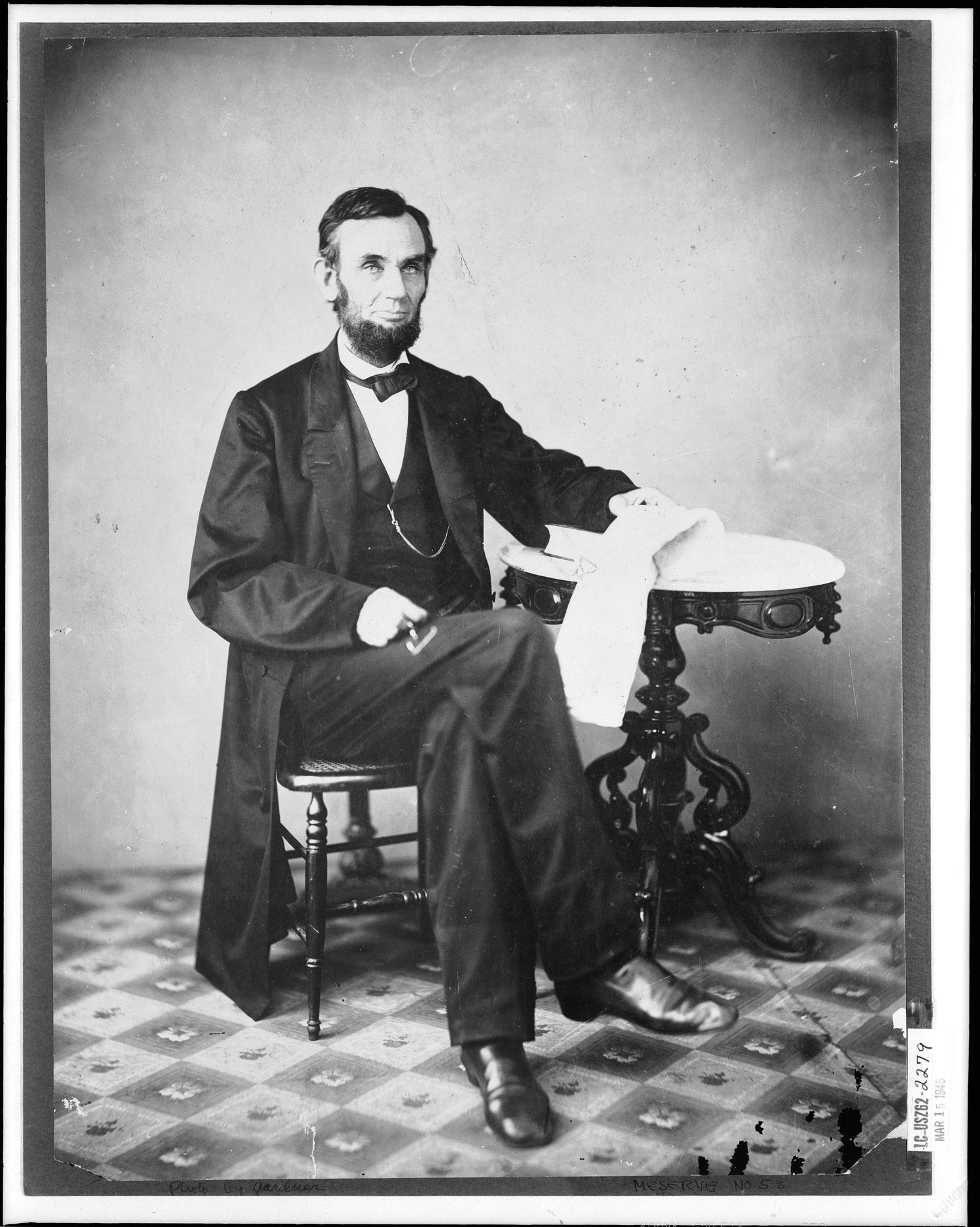
Gardner Lincoln portrait – print from large glass plate negative
Viewing the negative in person was amazing. The photo is magnificent: the clarity of it and the details were astonishing. Combined with the size of it (maybe 12×16 or bigger, I don’t remember exactly) it was an outstanding example of the photo technology of the time period, and indeed anytime period.
Now Gardner was an acknowledged expert in that wet plate style of photography. It was not an easy thing to get right: you needed to mix a chemical mixture just so and then apply it evenly to a glass plate. Then, you had a very small window of opportunity to take the photo – and then an equally small time-frame in which to get it developed. Gardner is rightly celebrated for his mastery of that technique for his work.
So our mystery today about Gardner isn’t about his photography. Rather, it stems from this rather abrupt remark at the end of the exhibit:
For reasons that remain mysterious, Gardner retired from photography in 1872 and went into the insurance business; he died a decade later, leaving no records except his photographs themselves.
That’s it? That’s all we know about him after 1872? That he became an insurance salesman?
Let’s consider this for a moment. Alexander Gardner is famous, at least among people who know anything about Civil War photography. I mean, I don’t know really much about Civil War photographers, but even I’d heard of him for this. He’s a photographer whose work has been celebrated for over a century. Somebody — probably many somebodys — put a lot of effort getting this retrospective exhibit together. There were detailed labels for all of the photos on display, mostly with historical information about the scene shown in the photo and/or the people in the image. It was actually a very nicely done exhibit from a historical view; there was not really much about the photography as photography, mind you, but they did a very nice job explaining quite a lot about the people involved and their histories.
So why is that last line about Gardner’s life so abrupt and almost dismissive of him? Our modern understanding of insurance salesmen and insurance companies is not always positive, and yet there’s no explanation how they got that information; there’s only the casual explanation that he made the change “for reasons that remain mysterious.” But why was that all they knew? After all, the exhibit talked about how he and his photos were quite popular, and he was employed by the government after the end of the war for addition government photography projects. Somehow, though that line diminished the extent of what Gardner had achieved with his photography by dismissively saying that “he went into insurance.”
Chris and I weren’t satisfied with this. So when we got home, Chris did a search on the Internet. It took him about 15 minutes to discover that while Gardner did indeed give up photography, he’d actually started a type of foundation to help people who didn’t have much money. It was “insurance” but of a very different sense from today. The “for reasons that remain mysterious” line is also misleading, as it seems clear when you read a fellow Mason’s eulogy about Gardner, you realize that Gardner’s dedication to his new cause (from 1872 until his untimely death in 1882) was motivated by altruistic and humanitarian reasons. Indeed, Gardner was elected as president of a branch of the Masons in 1882 just a month before his sudden death that year because of his “insurance” work. He and his accomplishments are eloquently eulogized and remembered with great respect by his peers.
So although what he did in 1872 was called insurance, in 1872 that term did not have the modern meaning of the word, and should have been understood with its 1872 meaning. How could this fact have been overlooked by the organizers? This is an exhibition at the Smithsonian, after all, where I would expect a little better.
But I think that overall some of Gardner accomplishments have taken a hit in recent years, as his work has been re-evaluated by of the rules of modern “documentary” photography. Today it’s expected that photojournalists don’t alter their photos at all (although a recent poll showed that a large percentage actually do]). Back during the Civil War, though, Gardner took his photos on the battlefields after the battles were over, since the camera equipment was not suitable for candid photos). He took photos of bodies on battlefields to document the horrors of warfare, and he is now thought to have sometimes moved bodies around to make a better photographic compositions, e.g. shifting a cannon ball, or rifle, or a body into a position to get a better shot. Although I don’t always agree with the revisionist views of the photos, I do know that it’s currently the thing to do to devalue Gardner’s photography by a modern understanding of photojournalism – I actually attended a lecture about this in Germany.
So did this modern negative view of Gardner’s practices explain why the Smithsonian didn’t dig just a little deeper to uncover what really happened to him after he gave up photography? Here’s a possible revision to the last line based on the information Chris discovered:
For humanitarian reasons, Gardner retired from photography in 1872 and worked with a group to help those in need.
You’re left with quite a different impression of Gardner after that, eh? His motivations seem positive, not nearly as “mysterious” as the exhibit would have you believe.
But the way the Smithsonian (mis)represents Gardner’s “insurance” work is itself mysterious enough to be a Monday Mystery.