Today on Monday Mysteries we’re back pondering the now-you-see-it, most-of-the-time-you-don’t quality of Mt. Rainer.
On Friday, I was over at the Mt. Rainer Vista walkway, which is a path that cuts across one of the quads at the University of Washington. I’ve walked along this several times now, as it’s on the way to the library where I’ve been doing some research for my early women photographers project.
BTW, the first woman to successfully reach the summit of Mt. Rainer back in the 1890s was an Oregon schoolteacher. She later became a highly regarded professional photographer in Seattle — picking up photography at the age of 61 She remained a photographer until the age of 91, when she retired.
But I digress. We’re here to talk about the mountain she climbed.
Now, normally, what I see from that path at UW is a big long stretch of campus, and a big fountain, with nothing in the distance. I mean, prior to Friday, there’s never been a Mt. Rainer “vista” visible from that vista viewpoint.
But on Friday, Mt. Rainer decided to come out in the open and pose for a photo op:
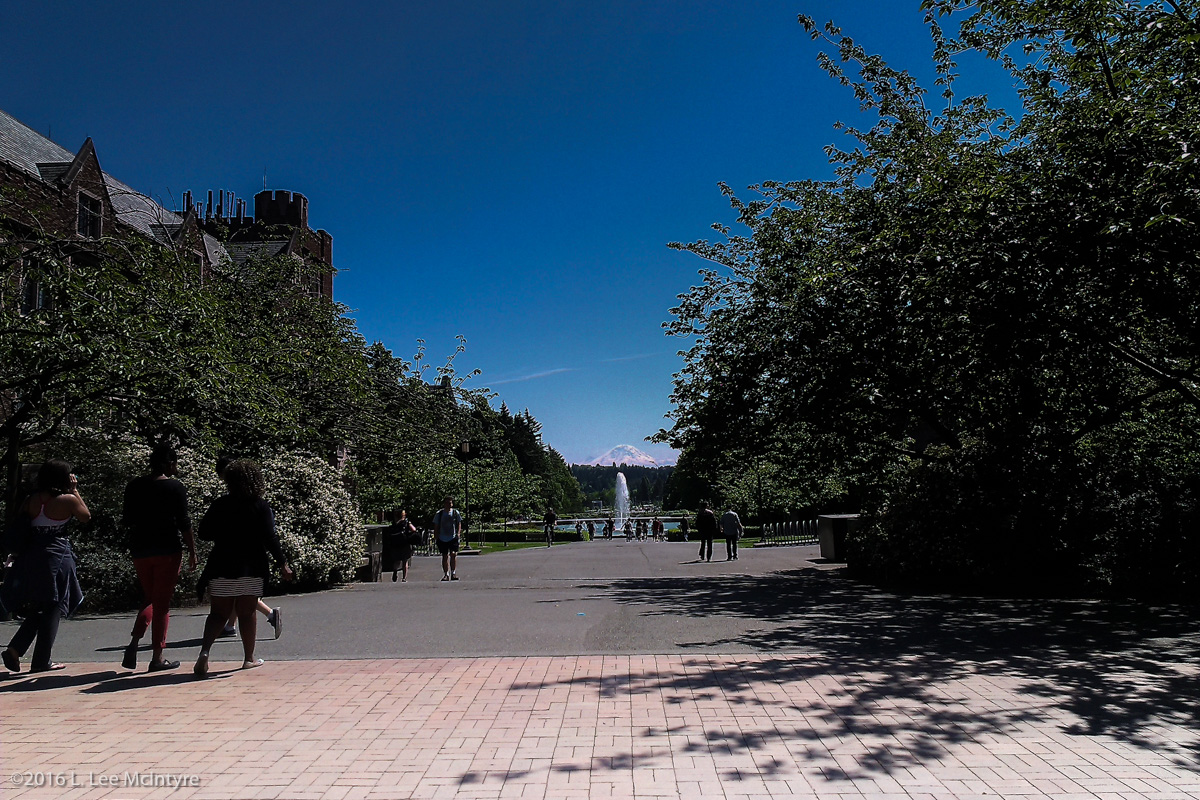
Mt. Rainer, seen from the Rainier Vista path at the University of Washington

Mt. Rainer off in the distance

A “closer” view of the mountain
Look how big that mountain is in the distance! It’s amazing when you see it it. But how can something that big not be visible more often?
Those photos were taken just before 2pm on Friday. Later that afternoon, as I was leaving the library around 5pm, I looked down the path and saw this:

“Believe in the Mountain”
Is there a mountain there? If you believe in the mountain … and are one with the mountain … you will see the mountain.
Skeptical? Here’s a version of that photo that has been adjusted to heighten the contrast between the mountain and the clouds around it.
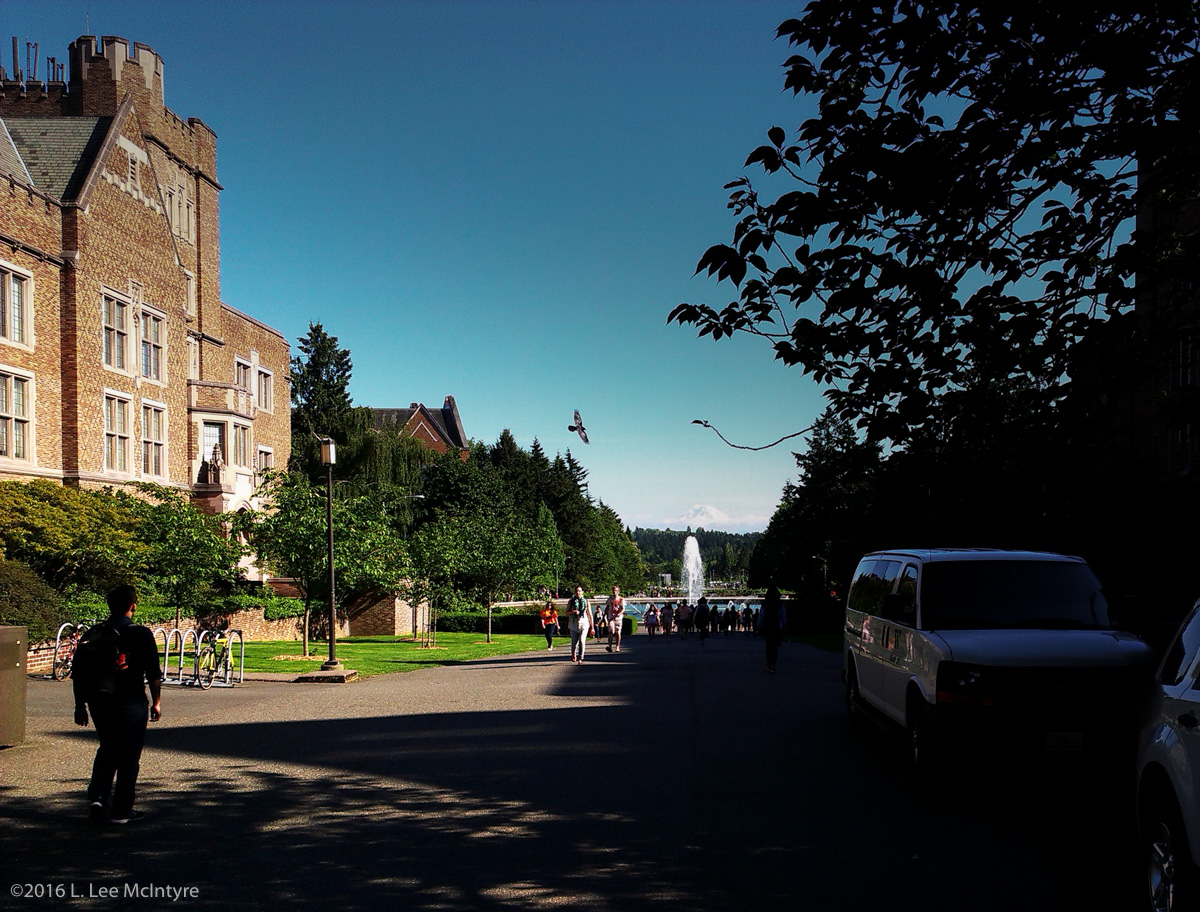
Believe in the Mountain – (contrast enhanced))
The fact that something as big as Mr. Rainer is so hard to spot much of the time, even when you know it must be there, is an ongoing mystery for me. And not just on a Monday. 
It sure is elusive. It hardly looks real.
When you finally get to see it, it looks magnificent. When it hides behind the clouds, it has good camouflage.