Today on Monday Mysteries we reveal not only the mystery of who won Eurovision 2016 (in case you missed it), but also we’ll unlock some of the mysteries around how the winning team won, even without winning. As it were.
We’ll have help for all this from some wonderful visualizations Chris did today. He made a couple of different ones. To play with one of them yourself, click here. It’s interactive; for example, click on the country names to see the lines for those countries highlighted in the chart).
He also did another one and exported some key things as static graphics for me to include in this post. When Chris talks about his visualizations in general, his stock phrase is “visualizations put ideas in your head.” What’s striking is that after seeing his visualizations, it will definitely put ideas in your head about the consequences of what can happen with ranked voting systems, which can lead losers to come out OK, and winners to pop up unexpectedly.
BTW, I should point out that “jury” in the graphics below refers to the professional jury that each country sends to Eurovision. The jury judges a separate performance done only for them on the day before the live Final is telecast. The “televoting” public uses their cell phone to vote immediately following the live Final performance. Each set of rankings (the jury and the televote) is then combined to come up with the final rankings and the overall winner. The new wrinkle this year is that the jury stuff was all announced separately from the televote, in part to avoid any country winding up with the dreaded “null” score. And indeed, no country ended up with 0 points.
So — to the results. At Saturday’s Eurovision Final (telecast live, even in the USA this year!), Ukraine was crowned the surprising winner. The odds on favorite (literally, with the odds makers) was Russia, followed by Australia, who respectively came in 3rd and 2nd.
Yes, I know. Australia? In a European contest? It’s a long story related to them competing last year as part of some special anniversary thing that I don’t recall right now. Let’s just say they have now stretched the definition of “European country” by quite a bit.
But I digress.
A couple of striking things that emerge from the visualizations that Chris did on how the voting shook out:
1. Ukraine won neither the jury vote, nor the public televote. But, when the two sets where combined, Ukraine won it all.

Ukraine – Eurovision 2016 results
2. The Top 10 Jury picks vs the Top 10 Televote picks are remarkably different.
Here’s the Top 10 from the Jury:
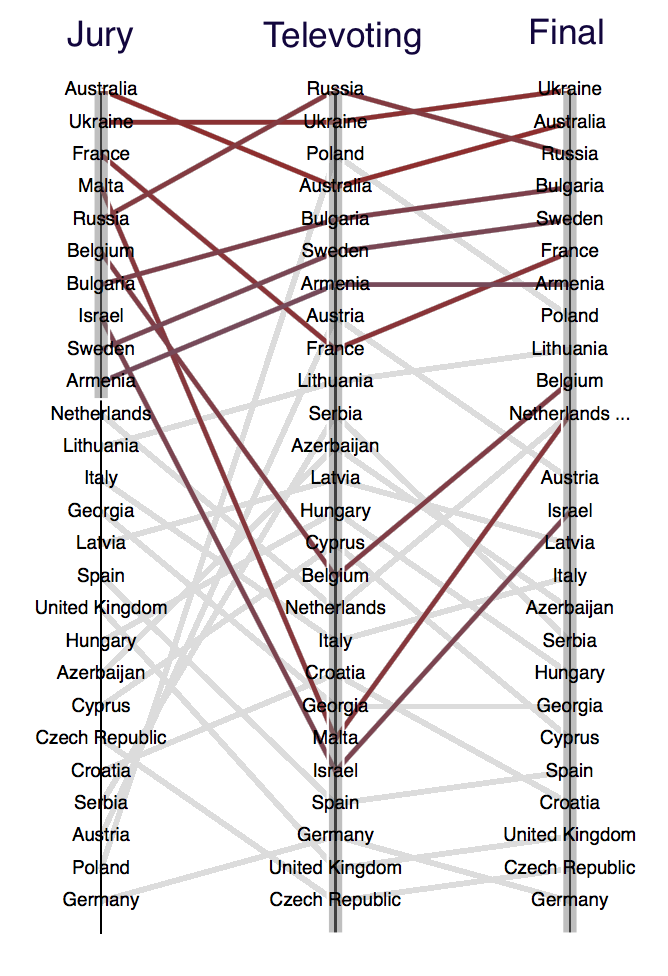
Jury Top 10 = Eurovision 2016
And here’s the Top 10 from the Televote:
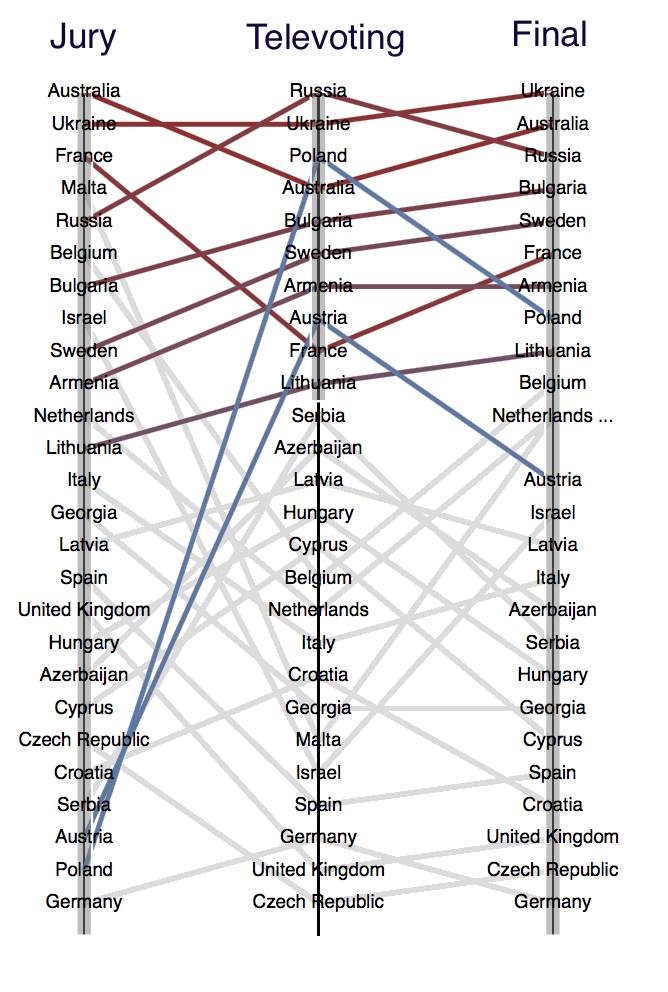
Televote Top 10 = Eurovision 2016
3. When the results are combined, there are some unexpected (to me) adjustments in the overall results. Note how Poland came in almost last in the Jury ranking, but their Televote rank was so much higher that they wound up in the top 10 overall:
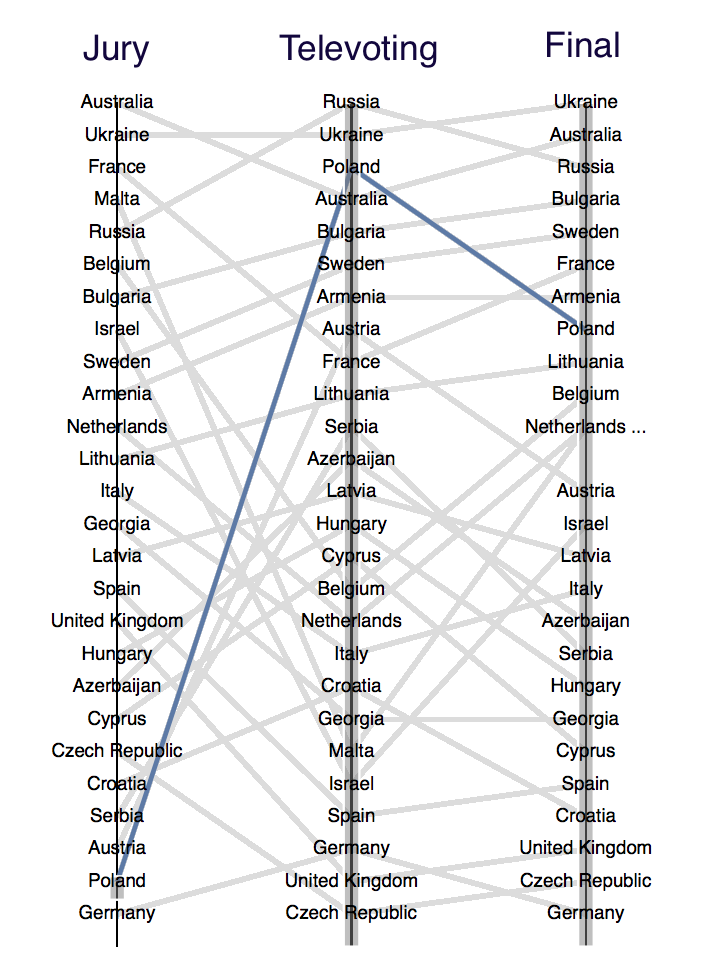
Poland – Eurovision 2016 results
4. Croatia, on the other hand, finished lower in the final rankings than in either of the Jury or Televote lists:

Croatia – Eurovision 2016 results
5. The final results are not a simple calculation of the rank order, but rather a points-based voting with points assigned based on rank. Chris did a version of the results that have horizontal bars underneath the country names. These bars show the percentage of the points that each country got, and it’s interesting to note that the winning percentage was 15% or less.

Eurovision 2016 full results
Anyway, I thought it was quite interesting to see these. Thanks, Chris, for letting me share these and the interaction one on the blog today! :-0
BTW, there was an odd semi-scandal of a sort connected to the results. Apparently the Danish jury member who filled out Denmark’s score card accidentally filled out their choices backwards, giving 12 points (top score) to Ukraine, when they’d really wanted to give Ukraine 0 points. Oy. According to the article I saw, though, that wouldn’t have made any difference to the overall winner. But still – there always has to be something wacky at Eurovision; glad to see that even though they changed the scoring system, some things never change. 